
Lizzie Borden: The Complete Story of America’s Most Famous Murder Case

Few names in American true crime carry the weight of Lizzie Borden. More than 130 years after two brutal killings in a quiet New England house, people still argue over one question: did she do it? This guide covers the facts, the evidence, the trial, the theories, and the legacy, so you can judge for yourself.
Who Was Lizzie Borden? Early Life and Family
Lizzie Borden was born Lizzie Andrew Borden on July 19, 1860, in Fall River, Massachusetts. Fall River was a booming textile-mill city, and her father, Andrew Jackson Borden, was one of its wealthy but famously frugal businessmen. He worked as an undertaker, landlord, and bank director, and he built a fortune estimated at around $300,000, a huge sum in the 1890s.
Lizzie’s mother, Sarah Anthony Morse Borden, died in 1863. This matters for one of the most common searches: Lizzie Borden’s age when her parents died. Her biological mother died when Lizzie was only two years old. Her father, Andrew, and stepmother, Abby Durfee Gray Borden, were killed in 1892, when Lizzie was 32. So the answer depends on which parent you mean.
Andrew remarried in 1865, and Abby became the only mother Lizzie really knew. Lizzie lived with her older sister Emma. Despite their wealth, the family lived modestly in a plain house on Second Street, in a less fashionable part of town, which was a constant source of tension. Lizzie and Emma reportedly resented that their father would not move them to the wealthier “Hill” neighborhood where Fall River’s elite lived.
Common Spellings: Lizzie Borden vs. Lizzie Bordan, Lizzy Bordan and More
Because the case is so widely discussed, people search for it in many ways. You will see lizzie.borden, lizzie bordan, lizzy bordan, lizzie border, lizzi borden, and even lizzie borden lizzie borden typed into search bars. The correct spelling is Lizzie Borden, and searches for Lizzy Borden history or Lizzy Borden murder lead to the same story told here.
When Did Lizzie Borden Kill Her Family? The Date of the Murders
If you are asking when was the Lizzie Borden case, the answer is Thursday, August 4, 1892. The date when Lizzie Borden killed her family, as the prosecution alleged, was one of the hottest days of that summer, and the killings took place inside the family home at 92 Second Street, Fall River.
Here is the timeline as reconstructed from testimony:
- Around 9:00 to 9:30 a.m.: Andrew Borden leaves the house for his usual business rounds.
- Between 9:00 and 10:30 a.m.: Abby Borden is attacked in the upstairs guest room. Her body is not discovered until later.
- Around 10:30 a.m.: Andrew returns and lies down on the sitting-room sofa for a nap.
- Around 11:10 a.m.: Lizzie calls to the maid, Bridget Sullivan, shouting that her father is dead and that someone came in and killed him.
- Shortly after: Neighbors and a doctor arrive. Abby’s body is found upstairs.
Both victims had been struck repeatedly with a sharp, hatchet-like weapon. Andrew Borden was 69, and Abby was 64.
How Old Was Lizzie Borden When She Killed Her Family?
This is one of the most searched questions on the case. How old was Lizzie Borden when she killed her family? According to the record, she was 32 years old on the day of the murders. In other words, Lizzie Borden’s age at the time of the crime was 32, and her sister Emma was about 41. It is worth repeating that Lizzie was tried and acquitted, so “when she killed her family” reflects the accusation, not a legal finding.
So, how old was Lizzie Borden when her parents died? Her mother died when she was two, and her father and stepmother died when she was 32.
How Many Times Did Lizzie Borden Hit Her Father?
Here the legend and the facts part ways sharply. According to the autopsy findings and medical testimony, Andrew Borden suffered roughly 10 or 11 blows to the head and face. Abby Borden suffered about 18 or 19 blows. Nowhere near 40.
So how many times did Lizzie Borden hit her father if she was the killer? Around ten or eleven. The much larger number comes from a popular skipping rhyme, discussed below.
Lizzie Borden Father Skull: The Most Chilling Evidence
The physical evidence was grim. At the trial, the prosecution presented the victims’ skulls to show the shape and size of the wounds and to argue they matched the small hatchet head found in the basement. The Lizzie Borden father skull exhibit became one of the most sensational moments of the proceedings, and newspapers reported that Lizzie reacted dramatically when it was displayed. The skulls were used to support the idea that the hatchet was the murder weapon, though the hatchet head had no handle, and prosecutors could never prove it was the weapon.
The Investigation: What Did Police Find?
Police found no blood-soaked clothing, no clear murder weapon, and no eyewitness. What they did find was a series of suspicious details:
- Lizzie’s shifting statements. During the inquest, her accounts of where she was that morning changed. She said she was in the barn loft, in the kitchen, or in the yard. Officers noted the barn loft dust looked undisturbed.
- The prussic acid. A pharmacist, Eli Bence, claimed Lizzie tried to buy prussic acid the day before the murders. The trial judge ruled this testimony inadmissible.
- The burned dress. Three days after the killings, Lizzie was seen burning a dress in the kitchen stove. She said it was stained with paint. The prosecution suspected blood.
- The note. Lizzie said Abby had received a note calling her away to visit a sick friend. No such note was ever found.
- The handleless hatchet. A hatchet head with a freshly broken handle was found in the basement, but no solid link to the wounds was ever established.
Lizzie was arrested on August 11, 1892, and a grand jury indicted her that December.
Lizzie Borden Motive: Why Did She Do It?
If Lizzie Borden did commit the murders, why did she do it? Historians and true-crime writers point to several possible motives:
- Money and inheritance. Andrew was wealthy and tightfisted. With both him and his wife dead, Lizzie and Emma stood to inherit a fortune.
- Property disputes. Shortly before the murders, Andrew had transferred property to Abby’s relatives, which angered the sisters.
- Resentment of Abby. Lizzie reportedly referred to Abby as “Mrs. Borden” rather than “Mother,” suggesting a cold relationship.
- Household tension. The family lived in a cramped, gloomy house despite their wealth, and there were reported arguments over money and status.
- The pigeons. A widely repeated story says that Andrew killed Lizzie’s pet pigeons with a hatchet not long before the murders. This is often cited as a possible trigger, though its reliability is debated.
The Lizzie Borden motive was therefore mostly financial and emotional, but motive alone is not proof, as the defense argued.
Was Lizzie Borden Found Guilty or Innocent?
Lizzie’s trial began on June 5, 1893, in New Bedford, Massachusetts, and lasted about two weeks. The prosecution was led by Hosea Knowlton and William Moody. Her defense team included former Massachusetts governor George Robinson.
Several key rulings helped the defense. The judge excluded Lizzie’s inquest testimony, and he also barred the prussic acid evidence. The defense stressed that no blood, no weapon, and no witness tied her to the crime, and it portrayed her as a respectable churchgoing woman who could not have committed such an act.
On June 20, 1893, after roughly 90 minutes of deliberation, the jury returned a verdict. So was Lizzie Borden found guilty or innocent? She was found not guilty. Lizzie Borden was acquitted of both murders. Legally, that means the answer to Lizzie Borden guilty is no, she was never convicted, even though public opinion in Fall River turned bitterly against her.
Did Lizzie Borden Actually Kill Her Parents? Did She Do It?
This is the heart of the mystery. Did Lizzie Borden actually kill her parents? The honest answer is that no one can say for certain. Consider both sides.
Arguments that Lizzie Borden did it:
- She was home during both killings.
- Her stories were inconsistent.
- She had a plausible financial motive.
- She burned a dress days later.
- There were few realistic alternative suspects.
Arguments that she did not:
- No blood was found on her person or clothes, which is difficult to explain given the ferocity of the attacks.
- No weapon was ever definitively linked to the crime.
- Nobody saw her commit the murders.
- The jury, made up of local men, believed the prosecution had not proved its case.
If you are asking did Lizzie Borden kill her father and stepmother, or did Lizzie Borden kill her dad and stepmom, the legal answer is that she was tried and acquitted. The historical answer is that many still suspect she did, and many others believe she was wrongly accused. Whether Lizzie Borden did it remains the central question of the case.
Alternative suspects have been proposed over the years, including Bridget Sullivan, the maid, Andrew’s brother-in-law John Morse, who was staying at the house, and an unknown intruder. None have ever been supported by strong evidence.
Was the Lizzie Borden Case Ever Solved?
Officially, no. Was the Lizzie Borden case ever solved? No one else was ever charged, and Lizzie was acquitted, so the case remains formally unsolved. That gap is exactly why the story continues to fascinate researchers, authors, and filmmakers. read about the tabitha
Is Lizzie Borden a Serial Killer?
Some people search for Lizzie Borden serial killer, but the term does not fit the facts. There is no evidence she killed anyone other than, allegedly, her father and stepmother in a single incident. Criminologists generally describe the murders as a double homicide, not the work of a serial killer. The label appears mostly in popular culture and sensational retellings.
Life After the Trial
After the acquittal, Lizzie and Emma inherited their father’s estate and moved to a large house called “Maplecroft” in the affluent Hill district of Fall River. Lizzie began calling herself Lizbeth. Locals shunned her, and she lived quietly, though she reportedly enjoyed theater and animals. Emma eventually moved out.
Lizzie Borden died on June 1, 1927, at age 66. Emma died just days later. Both are buried in Oak Grove Cemetery in Fall River, close to the family plot where Andrew and Abby lie.
Why Is Lizzie Borden So Famous?
Why is Lizzie Borden so famous? Several reasons combine:
- A shocking crime. A respectable, unmarried woman accused of hacking her parents to death was almost unthinkable in Victorian America.
- A media sensation. The trial was among the first to grab national headlines, with newspapers covering every twist.
- An unresolved ending. The acquittal left the question open, and that ambiguity feeds endless debate.
- A catchy rhyme. The rhyme gave the case a life beyond the courtroom.
The Lizzie Borden Rhyme
The Lizzie Borden rhyme is a folk skipping rhyme that appeared soon after the trial. It claims Lizzie took an axe and gave her mother forty whacks, then, after seeing what she had done, gave her father forty-one. The author is unknown, and the numbers are wildly inaccurate, as the medical evidence shows. Still, the rhyme is a big part of why the name is so recognizable even to people who know nothing else about the case.
The Lizzie Borden House History
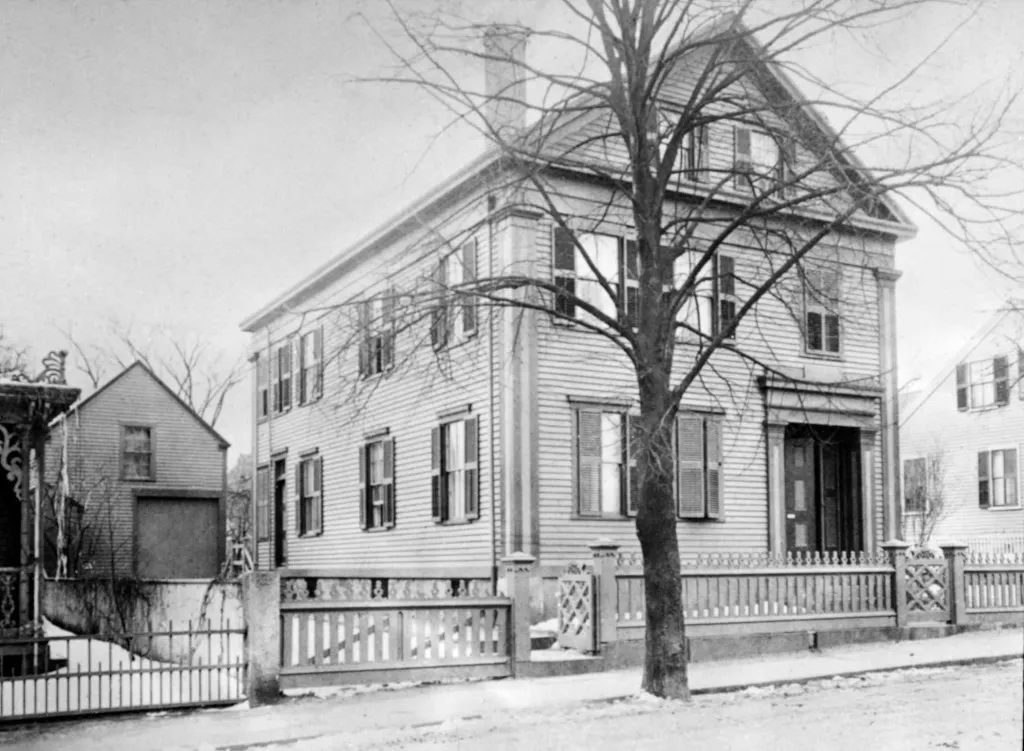
The Lizzie Borden house history is nearly as interesting as the case itself. The building at 92 Second Street stood in the center of Fall River and was sold after the murders. Over the decades it served as a private residence and later as a rooming house. Today, the Lizzie Borden house Massachusetts visitors travel to see has been carefully restored to resemble its 1892 appearance.
In 1996, the property opened as the Lizzie Borden Bed & Breakfast, now widely known as the Lizzie Borden Bed and Breakfast Museum. It offers daytime tours, and guests can even stay overnight in the same rooms where the events took place. If you are planning a visit, look up the Lizzie Borden bed and breakfast Fall River listing for tour times and booking. For more details, you can also search Lizzie Borden bed and breakfast Fall River Massachusetts or Lizzie Borden bed and breakfast museum Fall River MA. The Fall River Historical Society also holds artifacts and documents related to the case, and it is worth a visit if you want more historical context.
Lizzie Borden in Pop Culture
The story has inspired countless adaptations: films, television movies and series, a ballet, an opera, novels, and stage plays. There are also board games, card games, and online experiences, and searches like the Lizzie Borden game reflect how widely the case has been turned into interactive entertainment. Social posts and reviews with phrases such as “I witnessed the Lizzie Borden story” show how many people feel personally drawn into the mystery after visiting the house or watching a dramatization.
Whether it is a documentary, a podcast, or a ghost tour in Lizzie Borden Fall River MA, the case keeps finding new audiences. In fact, searches for Lizzie Borden Fall River Massachusetts consistently rank high for tourism and history alike.
Key Facts at a Glance
| Detail | Fact |
|---|---|
| Full name | Lizzie Andrew Borden |
| Born | July 19, 1860, Fall River, Massachusetts |
| Murders | August 4, 1892 |
| Victims | Andrew Borden (69) and Abby Borden (64) |
| Lizzie’s age at the time | 32 |
| Trial | June 1893, New Bedford, Massachusetts |
| Verdict | Not guilty, June 20, 1893 |
| Died | June 1, 1927, age 66 |
Conclusion
The Lizzie Borden case endures because it sits at the intersection of family secrets, wealth, gender expectations, and legal doubt. The jury said not guilty, yet the public has never stopped asking questions. Whether you see her as a wrongly accused woman or as a killer who escaped justice, one thing is certain: Lizzie Borden remains one of the most talked-about figures in American history.