
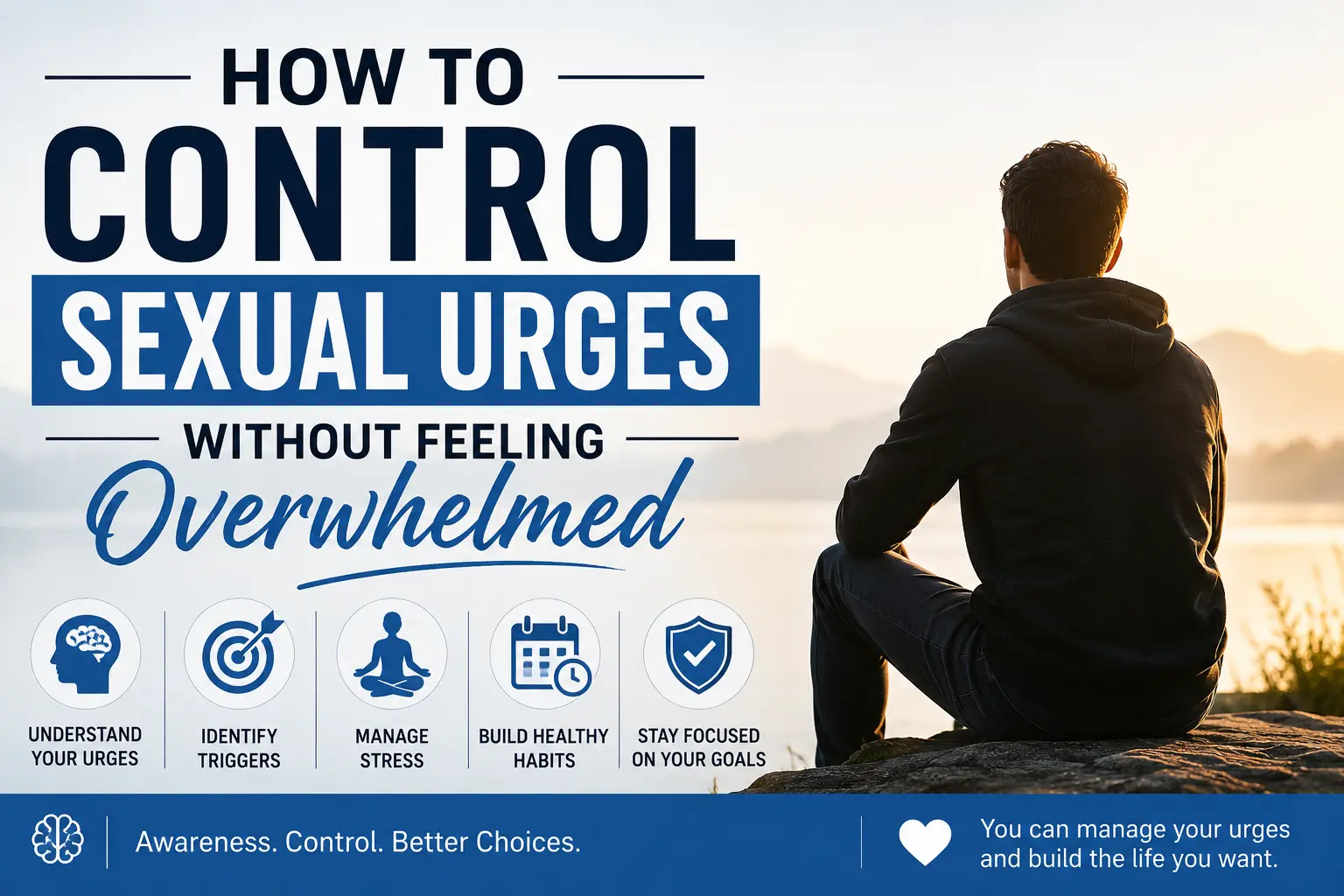
How to Control Sexual Urges Without Feeling Overwhelmed
Sexual urges are a normal part of human sexuality. Almost everyone experiences sexual thoughts, attraction, or desire at different points in life. However, some people may want to manage these urges because they are trying to avoid pornography, practice abstinence, maintain personal boundaries, or break a habit that no longer fits their goals.
The important thing to understand is that controlling sexual urges does not mean eliminating normal sexual feelings. A more realistic goal is learning how to recognize an urge, understand what triggers it, and decide how you want to respond.
This guide explains why sexual urges occur, what can make them feel stronger, and practical ways to manage them without feeling overwhelmed.
What Are Sexual Urges?
A sexual urge is a feeling of desire or impulse related to sexual thoughts, attraction, or behavior. Sexual desire is influenced by many factors, including biology, emotions, relationships, environment, stress, and personal experiences.
An urge can appear unexpectedly or develop gradually. For example, someone might experience stronger sexual thoughts after seeing triggering content online, feeling lonely, or spending a long period alone.
Having sexual urges is not automatically a problem. Sexual thoughts and feelings are a normal part of human life. The concern is more about how a person responds to those feelings and whether their behavior becomes difficult to control.
Compulsive sexual behavior, for example, may involve persistent sexual thoughts or behaviors that feel difficult to control and cause problems in relationships, work, education, finances, or emotional wellbeing.
Why Do Sexual Urges Feel So Strong?
Sexual desire involves both biological and psychological processes. Hormones, emotions, attraction, memories, stress, and environmental cues can influence the intensity of an urge.
Habits can also play a role.
When a person repeatedly experiences a particular trigger and responds to it in the same way, the brain can begin associating the trigger with the behavior. Over time, a situation that once seemed ordinary may become strongly connected with an urge.
For example:
Trigger → thought → urge → behavior → temporary relief
This pattern can become repetitive.
Understanding the pattern is useful because you can work on changing the trigger or response, rather than simply trying to force the urge to disappear.
Is It Possible to Completely Stop Sexual Urges?
For most people, completely eliminating sexual desire is not a realistic or necessary goal.
If you are trying to control sexual urges, it can be more helpful to focus on response control.
Instead of thinking:
“I should never have sexual thoughts.”
Try thinking:
“This is an urge, and I can choose how I respond to it.”
An urge is a feeling. It does not require immediate action.
This distinction can reduce the pressure you place on yourself and make it easier to approach the situation calmly.
1. Identify Your Sexual Triggers
One of the most effective starting points is understanding what usually happens before an urge appears.
Try paying attention to your patterns for several days or weeks.
Ask yourself:
- When do my urges usually appear?
- Am I alone when they happen?
- Am I bored or stressed?
- Am I using my phone?
- Did I recently see sexual content?
- Am I experiencing loneliness or frustration?
- Does lack of sleep make the urges stronger?
- What do I normally do immediately afterward?
You don’t need to record private details. A simple note about the situation and your emotions can be enough.
For example, you might discover that unwanted behavior happens primarily late at night while you are alone with your phone.
Once you identify that pattern, you can change the circumstances surrounding it.
2. Reduce Exposure to Triggers
If certain websites, social-media accounts, applications, or online environments consistently trigger unwanted sexual thoughts, reducing exposure can be helpful.
You could:
- Unfollow accounts that regularly post sexual content.
- Use content filters.
- Remove unnecessary social-media applications.
- Avoid websites that repeatedly trigger unwanted behavior.
- Keep your phone away from your bed.
- Limit unstructured browsing.
- Use your devices in environments that make you less likely to fall into an unwanted habit.
This isn’t about being afraid of every sexual thought. It is about making your environment more consistent with your personal goals.
3. Create a Pause Between the Urge and Your Response
One of the most useful skills is learning not to react automatically.
When an urge appears, pause for a moment.
You can mentally acknowledge:
“I’m experiencing an urge right now.”
Then give yourself time before deciding what to do.
During this period, change your activity. Stand up, leave the room, take a walk, start another task, or speak with someone you trust.
Creating this gap can help break the automatic connection between the urge and the behavior.
4. Change Your Environment
Sometimes changing your surroundings is easier than trying to fight an urge while remaining in the same situation.
For example, if you are alone in your bedroom and notice that your phone is triggering unwanted thoughts, move to another room and start a different activity.
You could:
- Go outside.
- Exercise.
- Work on a personal project.
- Read.
- Study.
- Talk to a friend.
- Spend time with family.
- Visit a public or shared environment.
The goal is to interrupt the pattern and give yourself an opportunity to make a deliberate choice.
5. Learn How to Handle Stress
Stress can influence many habits, including sexual behavior.
Some people may use sexual activity or pornography as a temporary way to escape feelings such as stress, loneliness, anxiety, frustration, or boredom. When that happens, simply trying to suppress sexual urges may not address the underlying issue.
Developing other ways to manage difficult emotions can therefore be valuable.
Healthy options include:
- Walking
- Exercise
- Meditation
- Journaling
- Reading
- Creative hobbies
- Social activities
- Relaxation exercises
- Maintaining a consistent sleep schedule
You don’t need to use all of these. Choose activities that realistically fit your lifestyle.
6. Build a Structured Daily Routine
A lack of structure can sometimes create more opportunities for unwanted habits.
A healthy routine doesn’t need to be complicated.
For example:
Morning: Work, study, or exercise
Afternoon: Productive responsibilities
Evening: Social activities, hobbies, or exercise
Night: Relaxation and reduced screen use
The objective is not to remain busy every minute. It is to create a balanced lifestyle where boredom and isolation are less likely to control your decisions.
Adequate sleep is also important. Being tired can make it harder to regulate emotions and make deliberate decisions.
7. Don’t Depend Entirely on Willpower
Willpower has limitations.
If you repeatedly expose yourself to the same trigger and simply tell yourself not to respond, you may eventually become mentally exhausted.
A better strategy is to combine self-control with environmental changes.
For example:
Instead of saying:
“I will never look at triggering content.”
you can also remove triggering accounts, install appropriate filters, change your nighttime routine, and keep your phone away from your bed.
This reduces the number of situations in which you need to rely on willpower.
8. Practice Mindfulness
Mindfulness involves paying attention to your thoughts and feelings without immediately reacting to them.
When a sexual thought appears, you can notice it without judging yourself.
You don’t need to argue with the thought or force it away.
Simply recognize:
“This thought is here, but I don’t have to act on it.”
Over time, this approach can help you become more comfortable with temporary urges instead of feeling that every urge needs an immediate response.
Mindfulness-based approaches can also be incorporated into professional treatment for problematic sexual behaviors.
9. Don’t Feel Guilty About Normal Sexual Feelings
If your goal is abstinence or avoiding pornography, it is important to distinguish between having a sexual thought and choosing a behavior.
You cannot always control when a thought appears.
You can work on controlling how you respond.
Feeling excessive shame about normal sexual feelings can create additional stress, which may make your overall situation harder to manage.
Instead, focus on your personal goals and the behaviors you want to change.
10. What If You Experience a Setback?
Changing an established habit isn’t always a straight line.
If you experience a setback, avoid thinking:
“I’ve failed, so I might as well give up.”
Instead, treat it as information.
Ask yourself:
- What happened before the behavior?
- What was I feeling?
- What triggered me?
- Was I tired or stressed?
- Was I alone?
- Was I using my phone?
- What could I change next time?
The answers can help you identify weaknesses in your current strategy.
A setback can therefore become an opportunity to improve your approach.
When Should You Talk to a Professional?
Having sexual urges does not automatically mean you need professional treatment.
However, consider talking to a qualified mental-health professional if sexual thoughts or behaviors consistently feel beyond your control or begin causing significant problems.
Possible warning signs include:
- Repeated unsuccessful attempts to control the behavior
- Significant distress
- Relationship problems
- Problems at work or school
- Financial consequences
- Continuing the behavior despite serious negative consequences
- Spending excessive amounts of time thinking about or engaging in the behavior
A professional can help you understand possible triggers and develop an individualized strategy. Treatment approaches can include psychotherapy, including cognitive behavioral therapy, depending on the person’s circumstances.
Frequently Asked Questions
How can I control sexual urges naturally?
Start by identifying your triggers, reducing exposure to unwanted sexual content, managing stress, maintaining a healthy routine, and creating a pause between an urge and your response.
Are sexual urges normal?
Yes. Sexual desire is a normal part of human sexuality. The presence of sexual thoughts alone does not mean that something is wrong.
How long does a sexual urge last?
There is no universal duration. The intensity and duration of an urge can vary depending on the individual and circumstances. Rather than focusing on exactly how long it will last, focus on allowing the feeling to pass without automatically acting on it.
Does avoiding pornography eliminate sexual urges?
Not necessarily. Sexual desire has many influences, so avoiding pornography may reduce certain triggers without eliminating normal sexual feelings.
Should I be ashamed of having sexual thoughts?
No. Sexual thoughts can be a normal part of human experience. If you are trying to change a particular behavior, focus on your choices rather than judging yourself for having thoughts or feelings.
Final Thoughts
Learning how to control sexual urges without feeling overwhelmed is primarily about developing awareness and choice.
You don’t need to eliminate every sexual thought. Instead, learn what triggers your urges, change environments that repeatedly lead to unwanted behavior, develop healthier ways to manage stress, and create a deliberate pause before responding.
If your goal is to avoid pornography, practice abstinence, or simply develop better control over your habits, start with small and sustainable changes.
And if sexual thoughts or behaviors feel genuinely uncontrollable or are significantly affecting your life, speaking with a qualified mental-health professional can provide personalized support.
You have not enough Humanizer words left. Upgrade your Surfer plan.